

TrichoScan Hair Analysis: A Complete Guide to Hair Fall Diagnosis
Published on 2026-10-12 | By Admin
Why Is Your Hair Falling More Than Usual?
Finding strands of hair on your pillow, in the shower, or tangled in your comb can be worrying. Many people immediately switch shampoos, start taking supplements, or try home remedies, hoping something will stop the hair fall.
But here's the reality—hair loss doesn't have a single cause.
It may be linked to genetics, hormonal changes, stress, nutritional deficiencies, scalp conditions, or even certain medical conditions. Since every person's hair loss journey is different, treating it without understanding the underlying cause may not deliver the results you're expecting.
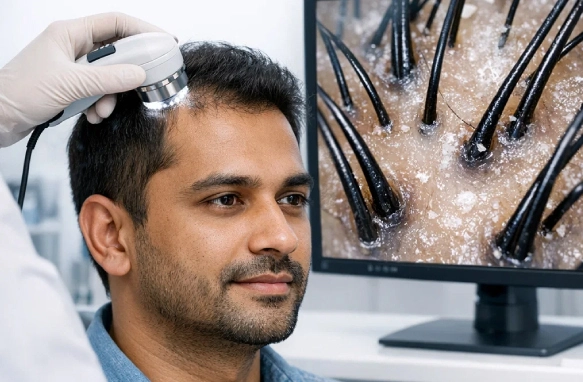
That's where TrichoScan Hair Analysis comes in.
Rather than relying on guesswork, TrichoScan uses advanced digital imaging technology to analyse your hair and scalp. It provides objective measurements of hair density, hair growth patterns, and follicle health, helping dermatologists and trichologists better understand what's happening beneath the surface.
In this guide, you'll learn how TrichoScan works, what it measures, who should consider the test, and how it supports personalised hair loss evaluation.
What Is TrichoScan Hair Analysis?
Imagine if your scalp could generate a report card.
Instead of guessing whether your hair is becoming thinner, TrichoScan measures it.
TrichoScan Hair Analysis is an advanced digital hair analysis system that evaluates your scalp and hair using high-resolution imaging software. It provides measurable information about your hair growth, density, follicle health, and hair growth cycle.
Rather than relying only on a visual examination, TrichoScan gives dermatologists objective data that can support accurate hair loss evaluation and personalised treatment planning.
Whether you're experiencing mild hair thinning or significant hair loss, understanding what's happening beneath the surface is often the first step towards finding the right solution.
How Does TrichoScan Work?
Wondering what actually happens during the test?
The entire procedure is quick, painless, and usually completed within 15–20 minutes.
Step 1: Consultation
Your dermatologist first understands your hair concerns, medical history, lifestyle, and scalp condition.
Step 2: Selecting the Scan Area
A small area of your scalp is identified for analysis. In some cases, a tiny section of hair may be trimmed to obtain clearer images.
Step 3: Digital Image Capture
High-resolution images of your scalp are captured using specialised imaging equipment.
Step 4: Software Analysis
The TrichoScan software analyses the captured images and calculates important hair growth parameters.
Step 5: Expert Interpretation
Your dermatologist reviews the report and explains what the findings mean, helping you understand the possible factors contributing to your hair loss.
What Does TrichoScan Measure?
Hair fall isn't just about how much hair you're losing.
It's also about how healthy your existing hair is.
TrichoScan evaluates several important parameters, including:
Hair Density – Measures the number of hairs growing per square centimetre.
Hair Shaft Thickness – Identifies whether your hair strands are becoming thinner over time.
Terminal vs. Vellus Hair Ratio – Helps detect early follicle miniaturisation, often seen in pattern hair loss.
Hair Growth Cycle – Estimates the proportion of hairs in the active (anagen) and resting (telogen) phases.
Early Hair Miniaturisation – Detects subtle changes before noticeable hair thinning occurs.
Together, these measurements provide a clearer picture of your overall hair health.
Who Should Consider a TrichoScan Hair Analysis?
You don't have to wait until hair loss becomes severe to get your scalp evaluated.
In fact, the earlier the underlying cause is identified, the easier it may be to manage certain types of hair loss.
A TrichoScan Hair Analysis may be beneficial if you:
You're Losing More Hair Than Usual
Finding a few strands every day is normal. But if you're noticing excessive hair fall while washing, brushing, or styling your hair, it's worth understanding what's causing it.
Your Hair Feels Thinner
Has your ponytail become smaller? Is your scalp becoming more visible? TrichoScan can help assess changes in hair density before they become more noticeable.
You're Experiencing Pattern Hair Loss
Whether it's a receding hairline, widening partition, or gradual thinning on the crown, TrichoScan can help monitor hair follicle changes associated with pattern hair loss.
You Have Patchy Hair Loss
If you've developed sudden bald patches or uneven hair loss, a detailed scalp evaluation can provide valuable information for further assessment.
You're Already Undergoing Hair Treatment
Wondering if your treatment is actually working?
Since TrichoScan provides measurable data, it can be used to monitor changes in hair density, thickness, and growth over time, helping track your progress more objectively.
Benefits of TrichoScan Hair Analysis
When it comes to hair loss, guesswork often leads to frustration. TrichoScan replaces assumptions with measurable information that helps guide personalised care.
Some of its key benefits include:
Non-Invasive and Comfortable
No injections, no painful procedures, and no downtime. The scan is quick, safe, and painless.
Objective Hair Measurements
Instead of relying only on visual observations, TrichoScan provides measurable data about your hair density, growth cycle, and follicle health.
Early Detection of Hair Changes
Subtle changes in hair thickness or follicle miniaturisation may be detected before significant hair loss becomes visible.
Helps Monitor Treatment Progress
Whether you're using medications, undergoing hair restoration treatments, or making lifestyle changes, TrichoScan allows your dermatologist to compare reports over time and evaluate your progress.
Supports Personalised Treatment Planning
Every person's hair loss is different. The insights from TrichoScan help dermatologists recommend treatment options that are better suited to your specific hair concerns.
TrichoScan vs Hair Mineral Analysis
Both TrichoScan Hair Analysis and Hair Mineral Analysis play valuable roles in understanding hair health—but they answer different questions.
While TrichoScan focuses on what's happening to your hair and scalp today, Hair Mineral Analysis looks at internal nutritional and mineral patterns that may influence hair health over time.
Rather than replacing one another, these assessments can complement each other when recommended by a qualified healthcare professional.
Tricho Scan Hair Analysis | Hair Mineral Analysis |
Examines the scalp and hair follicles using digital imaging | Analyses minerals and trace elements stored with a hair sample |
Measures hair density, thickness, growth patterns, and follicle health | Evaluates long-term mineral trends and possible heavy metal exposure |
Support hair loss diagnosis and treatment monitoring | May help identify nutrition or environmental factors that could influence hair health |
Provides immediate digital measurements | Requires laboratory analysis |
Commonly used during dermatology or trichology consultations | Often interpreted alongside clinical history and other investigations |
Think of it this way:
TrichoScan answers: "What's happening to my hair?"
Hair Mineral Analysis answers: "Could internal nutritional or environmental factors be contributing?"
Together, they can provide a more comprehensive understanding of your hair health when clinically appropriate.
What Happens After Your TrichoScan?
Your TrichoScan results are reviewed by your dermatologist or trichologist to understand your hair density, growth patterns, and scalp health. Combined with your medical history and symptoms, these insights help identify possible causes of hair loss and guide a personalised treatment plan, which may include scalp therapies, nutritional advice, lifestyle changes, or further investigations if needed.
Follow-up TrichoScan assessments can also track your progress over time, helping ensure your treatment is working effectively.
Final Thoughts
Hair loss can have many different causes, which is why there's no one-size-fits-all solution.
Instead of trying multiple products and hoping something works, understanding the underlying cause is often the first step towards effective treatment.
TrichoScan Hair Analysis provides an objective, non-invasive way to assess your hair and scalp health, helping dermatologists make more informed treatment decisions based on measurable data rather than assumptions.
At VCare, TrichoScan is integrated into a comprehensive hair assessment, where experienced specialists evaluate your scalp, discuss your concerns, and recommend personalised solutions based on your individual needs.
Because when you understand your hair better, you can make better decisions for its long-term health.
Frequently Asked Questions
1. What is TrichoScan Hair Analysis?
TrichoScan Hair Analysis is a digital hair assessment that measures hair density, growth patterns, and scalp health to support hair loss evaluation.
2. Is TrichoScan painful?
No. It is a completely non-invasive and painless procedure that usually takes about 15–20 minutes.
3. What does TrichoScan measure?
It measures hair density, hair shaft thickness, hair growth phases, terminal and vellus hair ratio, and early follicle miniaturisation.
4. Who should consider a TrichoScan test?
Anyone experiencing persistent hair fall, hair thinning, pattern hair loss, patchy hair loss, or those monitoring treatment progress may benefit from the test.
5. How is TrichoScan different from a regular scalp examination?
Unlike a visual examination, TrichoScan provides objective digital measurements that help evaluate hair growth and follicle health more accurately.
6. Can TrichoScan identify the cause of hair loss?
It helps identify hair growth patterns and scalp changes that support hair loss evaluation. Your dermatologist interprets the findings along with your medical history and other investigations.
7. Can TrichoScan monitor treatment progress?
Yes. Repeat scans allow your dermatologist to compare changes in hair density and growth over time, helping assess how well your treatment is working.
8. How should I prepare for a TrichoScan?
Your dermatologist may advise you to arrive with a clean scalp and avoid applying heavy hair styling products before the appointment.
9. Is TrichoScan suitable for both men and women?
Yes. The test can be used to evaluate various types of hair loss in both men and women.
10. When will I receive my results?
In most cases, the scan results are reviewed and explained during your consultation, allowing your dermatologist to discuss the next steps immediately.

 info@vcaretrichology.com
 +91 709 2525 252
 View All Locations


