
Acne Scar Types Explained: Causes, Diagnosis & Professional Treatment Options
Published on 2026-10-16 | By Admin
That one pimple is gone. But the mark it left behind? Still there.
If you've ever looked in the mirror and noticed a small pit, dent, or uneven patch where an acne breakout once was, you're not alone. Acne scars can stay long after active acne has cleared, and understanding acne scar types is the first step towards knowing what can actually help.
But here's something important: not every pimple leaves a scar, and not every mark left after acne is a scar.
Some changes are temporary and may fade with time. Others involve deeper changes in the skin and may need professional treatment.
So, what exactly causes acne scars? What are the different types? And how do you know which type you have?
Let's break it down.
What Are Acne Scars?
When acne causes deep inflammation, it can damage the skin tissue. As the skin heals, uneven collagen production can lead to different types of acne scars.
Too little collagen? You may develop depressed scars or pits.
Too much collagen? You may develop raised scars.
But remember, an acne mark isn't the same as an acne scar. Flat red, brown, or dark patches left after acne are usually acne marks and may fade over time.
Acne scars involve a change in skin texture or structure, appearing as pits, dents, or raised areas.
Why Do Acne Scars Form?
Ever wondered why one person gets a pimple and moves on, while another is left with a scar?
There isn't just one reason. Several factors can affect how your skin heals.
Delayed Acne Treatment
Leaving inflammatory acne untreated for a long time can increase skin inflammation and the risk of scarring. Early acne care is an important part of acne scar prevention.
Inflammatory Acne
Deep, painful, or inflamed acne is more likely to damage deeper skin layers and leave permanent scars than mild breakouts.
Picking or Squeezing Pimples
We know it's tempting, but picking or squeezing can worsen inflammation, damage the skin, and increase the risk of scarring.
Genetics
Some people naturally scar more easily. Genetics can influence how their skin heals and produces collagen after acne.
Your Skin's Healing Response
Everyone's skin heals differently. Too little collagen can lead to depressed scars, while excess collagen may cause raised scars.
So, what type of acne scar are you dealing with? Let's look at the different types next.
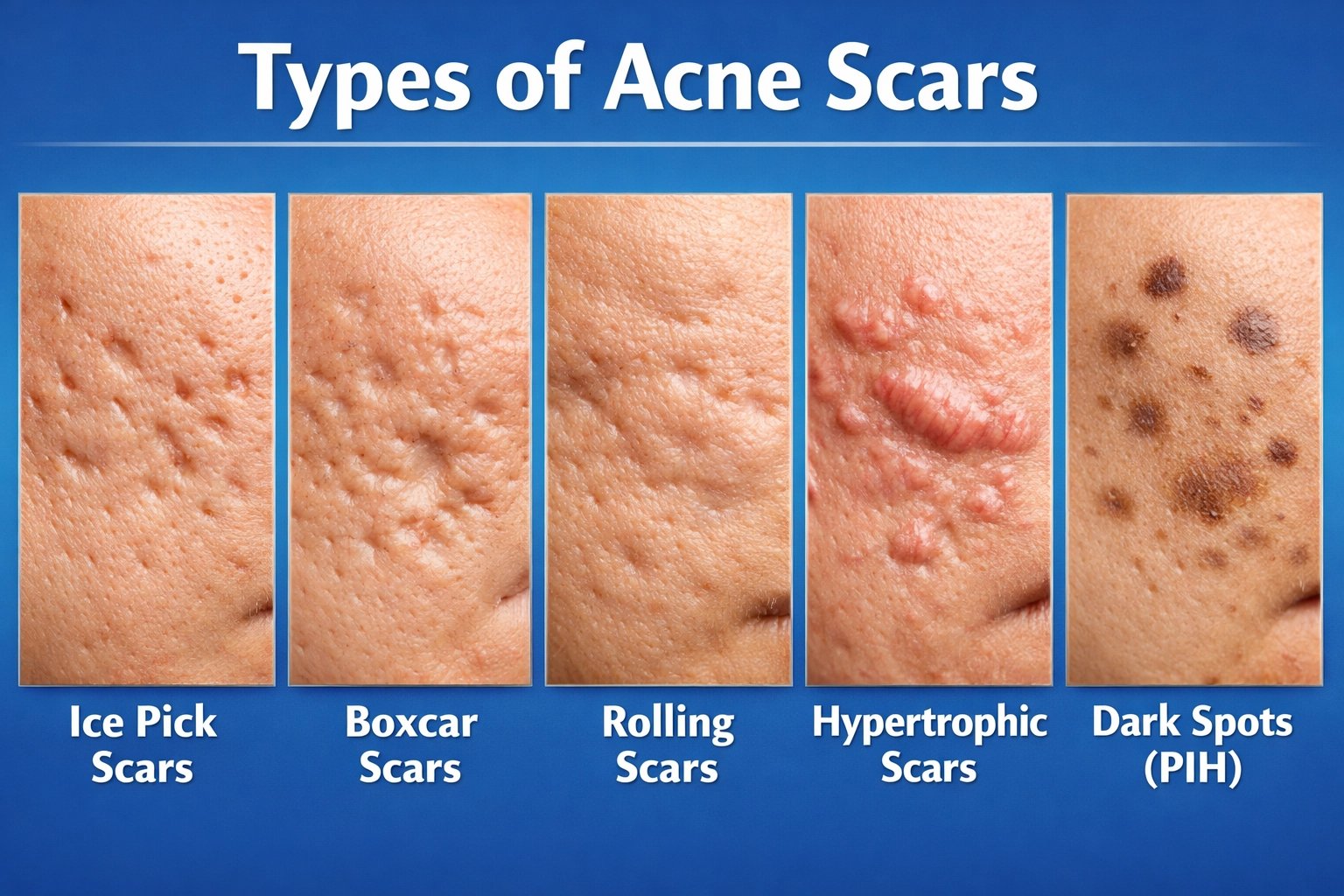
Different Types of Acne Scars
Here's where things get interesting.
Acne scars don't all look the same — and they don't all respond to the same treatment.
Some look like tiny holes. Some create broad depressions. Others appear raised above the skin.
Acne scars fall into two main groups::
Atrophic acne scars
- Ice pick acne scars
- Boxcar acne scars
- Rolling acne scars
Raised scars
- Hypertrophic acne scars
- Keloid scars
Let's look at what makes each one different.
Did You Know?
The appearance of an acne scar can give important clues about what happened underneath the skin during the healing process. This is why identifying the scar type is an important part of planning appropriate treatment.
Atrophic Acne Scars
Notice a dip or indentation where an old pimple healed?
You may have an atrophic acne scar. These scars form when the skin doesn't produce enough collagen during healing, leaving the area depressed.
Ice pick, boxcar, and rolling scars are the three main types of atrophic scars.
Ice Pick Acne Scars
Ice pick scars are small but deep. They look like narrow holes that extend deeper into the skin.
Because of their depth, they may require a more targeted treatment approach.
Boxcar Acne Scars
Boxcar scars are wider, depressed areas with clearly defined edges. They can be shallow or deep and may appear round or oval.
Their depth and shape can influence the treatment approach.
Rolling Acne Scars
Does your skin look wavy or uneven under certain lighting?
You may have rolling acne scars. They are usually wider and shallower than ice pick scars and form when fibrous bands beneath the skin pull the surface downward.
Hypertrophic Acne Scars
Not every scar creates a dip.
Hypertrophic scars are raised, firm areas caused by excess collagen during healing. Unlike depressed scars, they remain within the boundaries of the original injury.
Keloid Scars
Keloids are also raised scars, but they can grow beyond the original injury and may continue to enlarge over time.
If a raised scar continues to grow or becomes uncomfortable, professional evaluation is important.
And yes, you can have more than one type of scar. Ice pick, boxcar, and rolling scars can occur together, which is why identifying the exact scar type matters when choosing treatment.
Why Is Professional Assessment Important?
Have you ever tried a skincare product because it worked for someone else, only to see little or no improvement on your own skin?
That's because acne scars are not one-size-fits-all.
The scar type, depth, skin condition, and presence of active acne can all influence the treatment approach. At VCare, these factors are considered before creating a personalised plan.
The goal isn't simply to make a scar less noticeable overnight. It's about understanding your skin and choosing an approach that supports gradual improvement in texture and overall skin appearance.
What Happens If You Ignore Acne Scars?
An old acne scar may not necessarily become worse on its own. But that doesn't mean you should ignore new breakouts.
Why?
Because continued acne can create new scars while you're trying to manage the old ones.
If you're still experiencing frequent inflammatory acne, managing the active breakouts should be part of the overall plan. This can help reduce the risk of adding more scars while existing texture concerns are being addressed.
If your scars are long-standing, deep, or affecting your confidence, a professional consultation can help you understand your scar type and the treatment options available for your skin.
Professional Treatment Options for Acne Scars
Now that you know the different acne scar types, you may be wondering: Which treatment can actually help improve them?
The answer depends on your scar type, depth, skin condition, and overall treatment goals. There is no single treatment that works for every scar.
At VCare, acne scar care is personalized based on your individual skin concerns. Depending on your assessment, your specialist may recommend a standalone treatment or a combination approach.
1. PRP (Platelet-Rich Plasma)
PRP uses platelet-rich plasma to support the skin's natural repair process. It can help stimulate collagen production, improve skin texture, and reduce the appearance of acne scars over time.
It may also support firmer, smoother, and healthier-looking skin when used as part of a personalised acne scar treatment plan.
2. GFC Skin Treatment
GFC delivers concentrated growth factors to support skin repair and regeneration. It can help improve the appearance of acne scars, uneven texture, and overall skin quality.
By supporting collagen regeneration, GFC may help the skin look smoother, firmer, and more even over time.
3. StemGen Pro PRP Skin Treatment
StemGen Pro is an advanced PRP-based treatment enriched with 3× concentrated platelets. It is designed to support skin regeneration, improve acne-scar appearance, and refine uneven skin texture.
The treatment can also help promote a smoother, healthier-looking complexion as the skin undergoes its natural repair process.
4. CellGraft Skin Treatment
CellGraft is a regenerative skin treatment designed to support damaged skin and improve uneven texture. It may help minimise the appearance of acne scars by supporting cellular renewal and skin repair.
With an appropriate treatment plan, it can contribute to smoother, clearer, and healthier-looking skin.
5. Microneedling
Microneedling creates controlled micro-channels in the skin to stimulate its natural healing response. This encourages collagen and elastin production, which can help improve the appearance of certain depressed acne scars and uneven skin texture.
Over time, the skin may appear smoother, firmer, and more refined.
6. ExoGlo
ExoGlo is an advanced regenerative treatment designed to support skin healing and renewal. It can help improve the appearance of acne scars and textural irregularities by supporting collagen production and skin regeneration.
With a personalised treatment plan, it may help improve skin smoothness, clarity, and overall appearance.
7. Scariderm Kit
Professional treatment is only one part of acne scar care. Consistent homecare can also support the skin between treatment sessions.
The Scariderm Kit is formulated to help manage acne scars, post-acne marks, and uneven skin texture. Its active ingredients support skin renewal and can help maintain smoother, clearer-looking skin with regular use.
Final Thoughts
Acne scars can look different, form for different reasons, and respond differently to treatment. That's why understanding your acne scar types is more useful than trying random products or following a treatment simply because it worked for someone else.
The first step is simple: understand what you're dealing with.
If you're noticing persistent acne scars, uneven texture, or new scars after breakouts, a professional skin assessment can help you understand your skin and explore suitable treatment options.
At VCare, our skin experts assess your scar type, skin condition, and individual concerns before creating a personalised approach.
Ready to understand your acne scars better? Book a consultation with VCare and take the first step towards smoother, healthier-looking skin.
Frequently Asked Questions
1. What are the main types of acne scars?
The main types include atrophic scars, ice pick scars, boxcar scars, rolling scars, hypertrophic scars, and keloid scars.
2. Which acne scar is hardest to treat?
There is no single "hardest" scar for everyone. Deep scars, such as ice pick scars, can be challenging because they extend deeper into the skin. Treatment depends on the scar's depth, structure, and your individual skin condition.
3. Do acne scars go away naturally?
Some post-acne marks may fade naturally. True acne scars involve structural changes and may require professional treatment to improve their appearance.
4. How are acne scars diagnosed?
A skin expert assesses the scar's appearance, depth, structure, surrounding skin, and acne history to identify the scar type and determine suitable treatment options.
5. Which treatment is suitable for different acne scar types?
The treatment depends on the scar type and your skin condition. Options may include PRP, GFC, StemGen Pro PRP, CellGraft, Microneedling, ExoGlo, or Scariderm Kit based on your individual needs.
6. Can new acne lead to more scars?
Yes. New inflammatory acne can cause additional scarring, especially when breakouts are severe or repeatedly picked or squeezed.
7. Does sunscreen help prevent acne scars from getting darker?
Sunscreen can help protect the skin from UV exposure and reduce the darkening of post-acne pigmentation. It is an important part of skincare while managing acne marks and scars.
8. Can all acne scars be improved?
Many acne scars can be improved in appearance, but results vary depending on the scar type, depth, skin condition, and treatment approach. A realistic treatment plan should be based on individual assessment.

 info@vcaretrichology.com
 +91 709 2525 252
 View All Locations


